


Skip to content Skip to sidebar Skip to footer

Carnot Engines Redefining Heavy-Duty Power for a Decarbonized Future

The Challenge: How to replace the Diesel Engine?

At Carnot we are taking on the biggest challenge of our age; decarbonizing heavy-duty power and how to replace diesel engines. 

Hard-to-abate sectors — from shipping to long-haul road transport to remote power generation — face the biggest challenge in reaching net zero. Traditional internal combustion engine and especially diesel engines, waste much of their fuel energy as heat, and many cannot operate effectively on next-generation low-carbon fuels like hydrogen or ammonia.

Decarbonizing heavy-duty power requires technology that combines exceptional fuel efficiency with full fuel flexibility, without compromising on performance, reliability, or cost-effectiveness.

Carnot Engines – The World’s most efficient, multi-fuel engine

At Carnot Engines, we are developing the world’s most efficient engines. Conventional engines operate around 35% efficiency, where a Carnot Engine can operate at over 70% break thermal efficiency. By doubling fuel efficient, we half fuel consumption, delivering enormous cost savings to our customers.

A Carnot Engine can also work on any fuel, and switch anytime. A Carnot Engine can run on:

  • Hydrogen
  • Ammonia
  • Methanol
  • HVO/Biofuels
  • Biogas
  • LNG
  • Diesel

Our design targets >70% brake thermal efficiency — more than double the efficiency of many conventional diesel engines. By operating at higher temperatures and eliminating most cooling losses, Carnot Engines aim to dramatically reduce fuel consumption and slash greenhouse gas emissions across the toughest sectors.

Applications Across Multiple Sectors

Our technology is built for the hardest jobs in the most demanding environments:

  • Maritime power — main propulsion and auxiliary power units (APUs) for ships

  • Heavy-duty road transport — trucks, buses, and specialist vehicles

  • Off-grid and industrial power generation — remote mining, construction, and backup systems

These sectors demand high reliability, long service life, and global maintainability — our engines are being engineered to meet or exceed these benchmarks.

Driving Maritime Decarbonization

Shipping accounts for nearly 3% of global CO₂ emissions, and international regulations are tightening fast. Carnot Engines is working with leading shipping companies to demonstrate hydrogen and ammonia-fuelled engines in real-world maritime environments.

Upcoming trials include:

  • Hydrogen-powered auxiliary engine testing aboard a commercial vessel

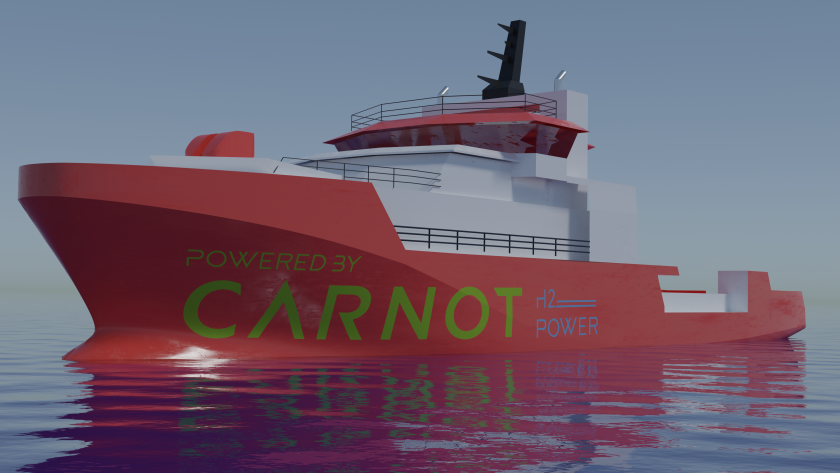
  • Hydrogen Engines for Shipping with the UK’s first hydrogen auxiliary engine sea trials 
  • Ammonia-fuelled APU retrofit projects for improved efficiency and emissions reduction

  • Ammonia Marine Engines and Auxiliary power units 
  • Fuel-Flexible high efficiency engines
  • Decarbonised Port Power

Designed for the Net-Zero Transition

Our approach solves three critical barriers to decarbonizing heavy-duty power:

  1. Fuel flexibility — switch between low-carbon fuels as supply chains develop

  2. High efficiency — reduced fuel use means lower emissions and operating costs

  3. Modular scalability — from smaller APUs to MW-scale maritime powerplants

This combination allows operators to begin cutting emissions now while staying adaptable for future fuels and standards.

In his recent book, ‘How to avoid a climate disaster’, Bill Gates focuses on electricity as the first major priority to consider in his manifesto for how to tackle the climate emergency. The reliable and low-cost supply of electricity has countless benefits across the economic and social spectrum. Gates also highlights that of the 860 million people around the world who do not have reliable access to electricity, 600 million of them are in Sub-Saharan Africa.

This is a challenge that needs to be given global significance as the region is faced with incredibly difficult decisions. Firstly, it is imperative that the population be given access to the reliable, low-cost power. The benefits filter into every aspect of society and day-to-day life including education, industry, internet access, lighting, domestic appliances, water management and countless others. Reliable low-cost energy helps trigger rapid acceleration in growth, the alleviation of poverty and improvements on quality of life in almost every industrial revolution experienced globally from the UK, USA, China and beyond.

The Economist

The huge challenge, however, is most industrial revolutions are powered by an abundant, low-cost fuel and the best candidate for this is coal. We are all familiar however with the negative impacts of coal power stations on the environment. Coal power is also the most dangerous to human health of any form of power generation, accounting for nearly 25 deaths per TWh. By comparison nuclear power accounts for just 0.03 deaths per TWh.

What then are the options going forward? In partnership with the Ethiopian Institute of Technology, Mekelle University Carnot has been exploring exactly this challenge. Is it possible to provide reliable, low-cost power to underserved populations and if so, how? As it turns out, whilst technology is a key component, it is only through the lenses of Society, Gender & Environmental considerations can the challenge be fully solved.

Gender equality in energy issues

In partnership with WISE we researched the GESI impact within Sub-Saharan Africa as part of an Energy Catalyst 7 Grant and found women in particularly were disproportionately impacted by energy poverty. Most of the energy came from Biomass. This required collection, handling, transport and often used inside. This is a huge contributor to female time poverty, is incredibly hard work and the fuel is often not from sustainable sources. More importantly however, the burning of biomass fuels inside accounts for about 2million deaths, the majority of whom are women and children.

There are a whole host of other practical, productive, and strategic needs which can be enhanced through the ready supply of electricity and fuel as seen below.

It was also found there were numerous social complications, often related to gender as well. Females were regularly omitted from key discussions surrounding energy decisions, far less represented in advanced education and thus less likely to be in a position to influences changes in energy infrastructure.

It was for these reasons and many more that we placed such a high emphasis on GESI issues when considering how our technology could be deployed in Sub-Saharan Africa and thus influenced many of our core project goals including:

  1. Promote gender equality and empower women in community-based renewable energy systems
  2. Integrate awareness of and attention to gender-specific concerns & perspectives into every aspect and level of the program
  3. Improve the quality of life of women and men through the improvement of access to efficient and affordable energy services
  4. Women are principal energy stakeholders, and should be recognised as key players, not only as suppliers and consumers of energy, but also as part of the solutions to sustainable energy and should be engaged directly in policy making and project design.
  5. Properly developed and deployed sustainable energy technologies would provide the twin benefits of effective responses to climate change (mitigation and adaptation) and the betterment of livelihoods of the poor in general and rural women.


Carnot High Efficency, off-grid generator

Using this perspective, the deploying of a high-efficient, fuel agnostic generator using the Carnot powertrain became a highly effective method for providing long-term, highly sustainable and environmentally friendly power which could have countless secondary benefits.

Equally as critical, this research heavily influenced our GESI policy as a company. We are an equal opportunity employer and have GESI values hardwired into our employment & retention policies. We are looking to help promote GESI values in STEM careers and believe that implementing a gender balance across every aspect of our business is a strategic imperative.